Elisabetta Iavarone1, Jane Simko2, Ying Shi1,2, Marine Bertschy2, María García-Amado3, Polina Litvak1, Anna-Kristin Kaufmann1, Christian O’Reilly1, Oren Amsalem4, Marwan Abdellah1, Grigori Chevtchenko1, Benoît Coste1, Jean-Denis Courcol1, András Ecker1, Cyrille Favreau1, Adrien Christian Fleury1, Werner Van Geit1, Michael Gevaert1, Nadir Román Guerrero1, Joni Herttuainen1, Genrich Ivaska1, Samuel Kerrien1, James G. King1, Pramod Kumbhar1, Patrycja Lurie1, Ioannis Magkanaris1, Vignayanandam Ravindernath Muddapu1, Jayakrishnan Nair1, Fernando L. Pereira1, Rodrigo Perin2, Fabien Petitjean1, Rajnish Ranjan1, Michael Reimann1, Liviu Soltuzu1, Mohameth François Sy1, M. Anıl Tuncel1, Alexander Ulbrich1, Matthias Wolf1, Francisco Clascà3, Henry Markram1,2 and Sean L. Hill1,5,6,7
1Blue Brain Project, École polytechnique fédérale de Lausanne (EPFL), Geneva, Switzerland
2Laboratory of Neural Microcircuitry (LNMC), École polytechnique fédérale de Lausanne (EPFL), Lausanne, Switzerland
3Departamento de Anatomía, Histología y Neurociencia, Facultad de Medicina, Universidad Autónoma de Madrid, Spain
4Department of Neurobiology, Hebrew University of Jerusalem, Jerusalem, Israel
5Department of Psychiatry, University of Toronto, Canada
6Department of Physiology, University of Toronto, Canada
7Krembil Centre for Neuroinformatics, Centre for Addiction and Mental Health (CAMH), Toronto, Canada
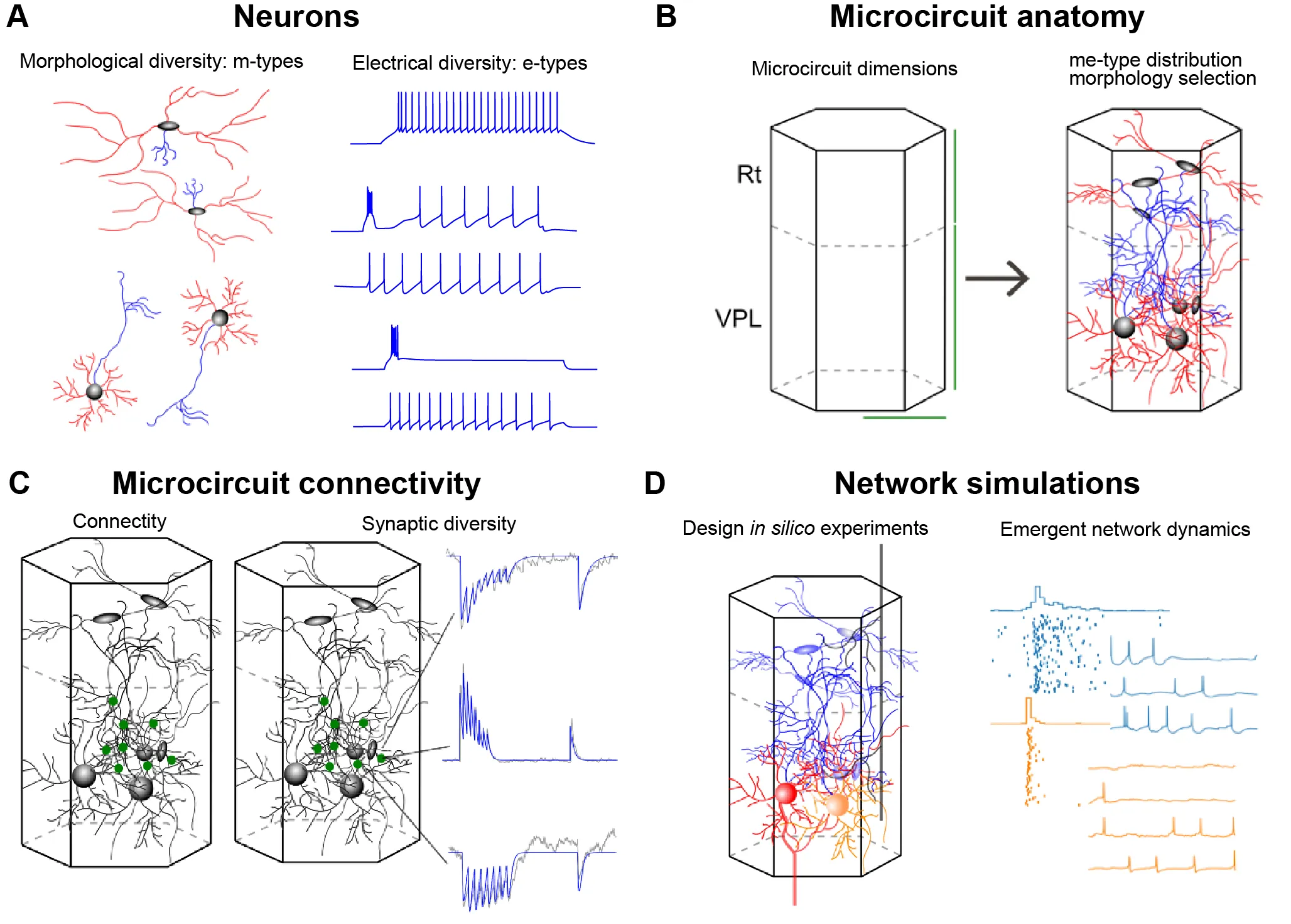
Thalamoreticular circuitry plays a key role in arousal, attention, cognition, and sleep spindles, and is linked to several brain disorders. A detailed computational model of mouse somatosensory thalamus and thalamic reticular nucleus has been developed to capture the properties of over 14,000 neurons connected by 6 million synapses. The model recreates the biological connectivity of these neurons and simulations of the model reproduce multiple experimental findings in different brain states. The model shows that inhibitory rebound produces frequency-selective enhancement of thalamic responses during wakefulness. We find that thalamic interactions are responsible for the characteristic waxing and waning of spindle oscillations. In addition, we find that changes in thalamic excitability control spindle frequency and their incidence. The model is made openly available to provide a new tool for studying the function and dysfunction of the thalamoreticular circuitry in various brain states.
https://doi.org/10.1016/j.celrep.2023.112200
This Blue Brain Project (BBP) Nexus Studio is a public resource associated with the release of the first biologically-detailed model of a thalamic microcircuit. It is a resource for the community to explore how the BBP reconstruction workflow developed for the neocortex (Markram et al., 2015) has been adapted to model another brain region.
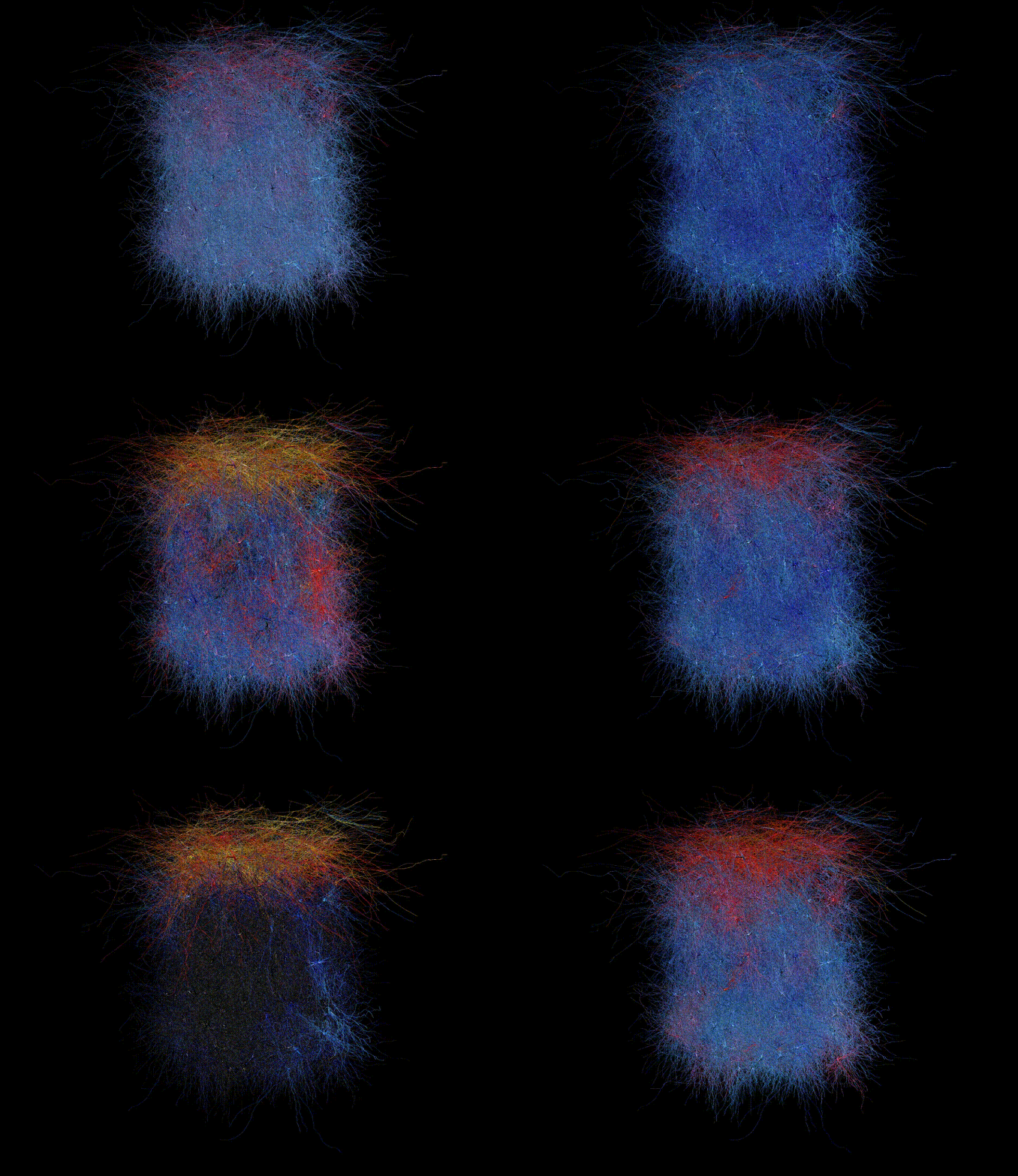
In this Studio, it is possible to download experimental data used for model building and validation, neuron models, circuit model in sonata format, and videos of network simulations. Note that in this Studio, we use the ME-type names “cAD_noscltb” instead of Rt_RC’s “cAD_ltb”, “cNAD_noscltb” instead of Rt_RC’s “cNAD_ltb”, “dAD_ltb” instead of VPL_TC’s “cAD_ltb”, and “dNAD_ltb” instead of VPL_TC’s “cNAD_ltb”.